


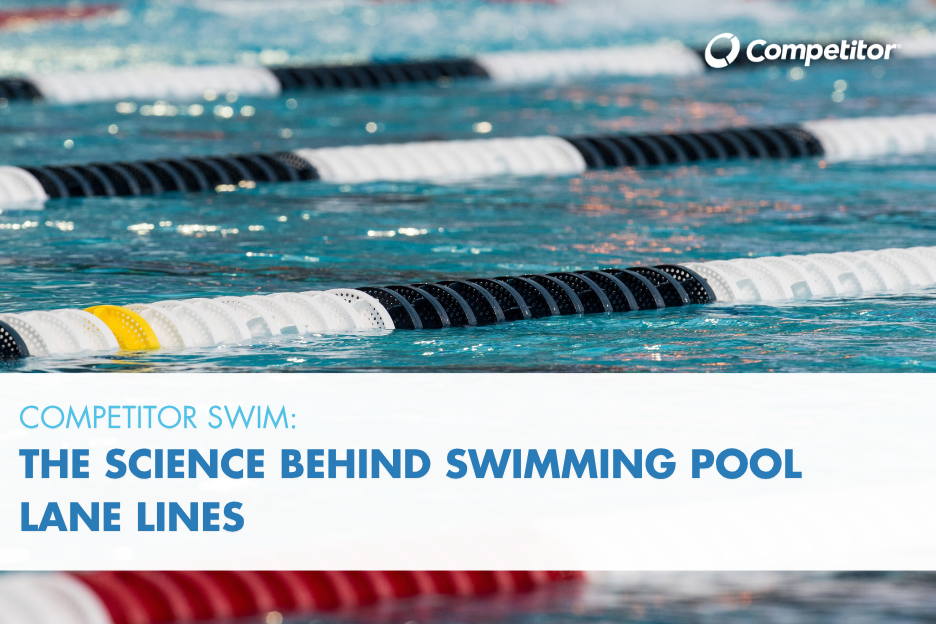
When choosing lane lines for your pool or aquatic facility, you may come across terms like “wave reduction”, “turbulence control”, and “flow-through design”. These are more than just fancy descriptors. Rather, these technical features determine how effectively a lane line manages the water displaced by swimmers.
To really understand how each of these features work together to create smoother water, let’s start with what causes turbulence in a pool environment.
What Causes Turbulence in a Pool Environment?
In a pool, every swimmer creates waves. That energy might come from:
- Starts and relay exchanges
- High-tempo kicking
- Butterfly and breaststroke strokes
- Sprint finishes
- Flip turns and open turns
- Multiple swimmers training at once
Wave energy reduction refers to a racing lane line’s ability to absorb and disperse waves generated by swimmers. By limiting the wave energy that travels into neighboring lanes or reflects back into the swimmer’s own lane, the lane line helps create more consistent conditions throughout the pool. This in turn creates a more equitable racing environment, so swimmers in lanes near the walls are not at a disadvantage compared with those in the center lanes.
Lane Line Design Factors that Affect Turbulence Control
We’ve established that the right racing lane line can help limit water movement so swimmers can focus on their stroke, pace, and performance—not the wake coming from the next lane. But what sets apart lane lines that effectively reduce waves from those that don’t?
It all comes down to how the lane lines are engineered. From hydrodynamics to materials science, there are specific elements that come into play when creating lane lines that enable swimmers to achieve peak performance, reduce turbulence, and foster fair competition.
Ultimately, a lane line’s ability to control turbulence depends on a few several design factors:
- Disc size and overall lane-line diameter
- Disc shape and water-flow openings
- Lane-line tension
Disc Size and Lane-Line Diameter
Research on competitive swimming lines has found that wave-damping performance increases with larger lane-line diameters and becomes particularly important at higher swimming speeds found during high-stakes competitive events.
Which is precisely why Competitor swim racing lanes are fully assembled with discs of either 4″ or 6″ diameter. In fact, our 6″ Gold Medal racing lanes are proven to dampen waves 70% more than the 4″ discs and are used more often by high-level competitive aquatic facilities, such as college and Olympic swimming pools.
Disc Shape and Flow-Through Design
Disc size alone does not determine how well a swimming lane line reduces waves. The shape, spacing, and construction of the individual discs also influence how water moves through and around the lane line.
How Flow-Through Design Reduces Waves
A flow-through design allows water to pass through the lane line’s components while the discs disrupt wave movement. This differs from a solid barrier, which can redirect waves rather than reduce them.
With Competitor lane-lines, discs are designed with five fins that extend from a central hub. Those fins combined with a perforated web design help dampen and break up that wave energy as it reaches the lane line. Each disc is also designed to rotate independently of the others, allowing the swimmer’s wake and energy to be absorbed along the length of the lane line.
This is especially important because swimmer-generated waves do not always hit a lane line straight on. Competitor’s disc design is engineered to manage water movement coming from different angles, helping reduce turbulence throughout the pool.
Lane Line Tension
Even the highest-quality swimming pool lane line must be installed at the correct tension to perform as designed. Proper tension helps the lane line stay aligned, absorb wave energy between lanes, and create a more consistent swimming environment for training and competition.
Anchor systems play a critical role in maintaining that tension. Secure anchor points at both ends of the pool hold lane lines in position and are engineered to withstand the forces created by swimmer movement and water turbulence.
If a lane line is too loose, it can shift out of position and may not effectively dissipate wave energy. If it is too tight, it can place unnecessary strain on the anchors, reels, and other hardware. The right balance keeps lane lines stable, properly aligned, and reliable, so athletes can focus on performance without disruption.
Competitor offers two types of tensioner systems designed to help keep pool lane lines properly aligned and securely in place.
Engineered for Competitive Pool Environments
The most effective racing lane lines are not simply pool dividers. They are an essential piece of competitive swimming equipment designed to manage wave energy, reduce turbulence, and help create fairer conditions in every lane.
Competitor Swim has manufactured racing lane lines since 1968. Our 4-inch Standard Racing Lanes and 6-inch Gold Medal Racing Lanes can be custom assembled for a facility’s pool length and preferred color pattern, with options designed for recreational, training, and competition environments.
Frequently Asked Questions
How do swimming lane lines reduce turbulence?
Swimming lane lines reduce turbulence by breaking up, absorbing, and dispersing the wave energy swimmers create. A flow-through design allows water to move through the line’s discs and floats while disrupting waves before they enter adjacent lanes or bounce back into the original lane.
Why does a flow-through design matter with racing lanes?
A flow-through design allows water to pass through the lane line’s components while the discs disrupt wave movement. This differs from a solid barrier, which can redirect waves rather than reduce them.
Why is wave energy reduction important in competitive swimming?
Wave energy reduction helps prevent swimmer-generated wake from disrupting nearby athletes. It supports more consistent water conditions, reduces cross-lane interference, and helps create a fairer environment for races and structured training sessions.
Are larger swimming lane lines better for wave reduction?
Lane-line performance depends on the complete engineering of the system, including diameter, disc design, material, spacing, flow-through openings, tension, and installation. However, research has found that wave-damping efficiency increases with lane-line diameter over the range studied.
What is the difference between a pool lane rope and a racing lane line?
“Pool lane rope,” “lane line,” and “pool lane divider” are often used interchangeably. A competition-grade racing lane line is specifically engineered to manage wave energy and turbulence, while some basic pool dividers may primarily provide visual separation.
